Rabu, 24 April 2019

iFixit Teardown of Samsung Galaxy Fold Reveals Likely Design Flaw - MacRumors

iFixit today published its teardown of Samsung's Galaxy Fold, offering more details on a potential flaw in the device, which has now been delayed following reports of several broken review units.

Essentially, it looks as though Samsung was so focused on perfecting the folding mechanism on the smartphone/tablet hybrid that it made a major oversight: providing adequate protection against the ingress of debris between the OLED screen and the chassis bezel.

To achieve the fold, the thin bezel that surrounds (and protects) the screen leaves a gap where the two halves meet... This 7 mm gap doesn't seem like a huge deal, but it leaves the display exposed—so should something accidentally enter, it's curtains for the screen. (Oops.)

When closed, the screen is protected—but the spine is flanked by massive gaps that our opening picks hop right into. These gaps are less likely to cause immediate screen damage, but will definitely attract dirt.

Many reviewers experienced multiple issues while testing the device, including a random bulge appearing on the display, as well as flickering and failing screens. In many cases, the issues were enough to make the $1,980 device completely unusable.

In a statement, Samsung said its initial findings from the inspection of reported issues on the display showed that they could be associated with impact on the top and bottom exposed areas of the hinge. It also said "substances" were found inside the device, which affected the display performance.

As iFixit notes, it will be interesting to see how folding designs manage to overcome these weaknesses in future - if indeed they have a future. Following Samsung, Huawei and Xiaomi revealed that they too will launch folding smartphones, and there are signs Apple is looking into the possibility of a foldable iPhone. Apple has filed several patent applications related to folding phones that variously fold inward, outward, and both inward and outward.

Potential point of entry for debris ingress (Image: iFixit)

As for the Galaxy Fold, the months ahead look increasingly uncertain. One day after Samsung said it was delaying the launch of the hybrid handset, the company announced that it would be retrieving all Fold devices that were distributed to reviewers.

In an email to pre-order customers about the delayed launch, Samsung said that it will update customers with more specific shipping information in two weeks. "Your pre-order guarantees your place in the queue for this innovative technology," the company promised.

Let's block ads! (Why?)


https://www.macrumors.com/2019/04/24/ifixit-teardown-of-samsung-galaxy-fold/

2019-04-24 11:02:00Z
52780272877586

iFixit’s Galaxy Fold teardown reveals its biggest design flaw - The Verge

Though it’s not technically the first time we’ve seen the innards of the now-delayed Samsung Galaxy Fold, iFixit’s teardown of the folding device is absolutely the most informed and detailed we’ve seen. Following up on its post speculating on the possible causes of the various screen breakages we’ve seen on review units, iFixit’s teardown analysis seems to reveal a fundamental design tradeoff Samsung had to make — one that may have doomed the phone.

It seems as though Samsung focused quite a bit on ensuring the mechanics of the hinge would be a sturdy and dependable mechanism for folding and unfolding a screen. Yet for whatever reason, the Galaxy Fold does not have enough protection against the ingress of debris. And because that screen is so incredibly delicate (as any OLED is if it’s not protected by something like Gorilla Glass), that was a significant risk.

It was a risk that didn’t pay off, as no fewer than three different review units developed bulges under their screens at the hinge. Our unit exhibited the issue, as did the unit that was given to Blick, as did the unit given to Michael Fisher. One of those bulges — the one on our review unit — ultimately damaged the screen.

We still can’t know the full reasoning behind Samsung’s decision to delay the launch of the phone, but this debris/bulge problem feels much more fundamental than the fact that the protective layer on the top looks like a screen protector that should be peeled off (but, again, should not be as that breaks the screen as well). The bulk of the rest of the reviewers who had broken screens tried to remove that layer — a natural inclination since the review unit packaging didn’t have any warning on it.

In any case, iFixit’s teardown reveals that the hinge mechanism for folding and unfolding the phone is incredibly robust and — from a certain perspective — well designed. It certainly seems plausible that the hinge itself could stand up to Samsung’s oft-touted 200,000 robot-powered unfoldings without issue. As iFixit writes, there are two separate types of hinges: a center hinge that “distributes the opening force equally, ensuring that the two halves of the phone open synchronously” and two side hinges that “allow for some horizontal play in order to absorb any torsion force.”

Though the hinge itself might be strong and rigid enough to prevent direct damage to the screen through twisting or flexing, it seems as though Samsung was unable to come up with a design that kept dust or debris from getting inside it. Looking at the front of the phone, there’s a 7-mm gap between the screen and the edge of the phone right at the top and bottom of the crease. For whatever reason, Samsung didn’t try to fit a flexible rail over that portion of the screen to prevent dust from getting in.

That small gap probably isn’t the biggest problem, though. No, the biggest problem appears to be the gaps on the back of the hinge. iFixit notes that “the spine is flanked by massive gaps that our opening picks hop right into. These gaps are less likely to cause immediate screen damage but will definitely attract dirt.”

I can’t say with any degree of confidence that those rear gaps are how debris got into my review unit, but that’s my current working theory. I also can’t help but think of the silicone protective layer Apple eventually added to MacBook keyboards and whether Samsung should have considered adding such a thing to the Fold.

As of this writing, Samsung has still not informed us what the debris was that broke our review unit — but at this point, it hardly seems to matter if it was sand, lint, the molding clay we briefly used (and rigorously cleaned off) to hold the phone up, or something else entirely. The bottom line is that it seems as though the basic design of the Galaxy Fold made it entirely too easy for debris to get under the screen. And even though the device specifically doesn’t have an IP rating for dust, it sure seems like the next iteration should get one.

As for the rest of the teardown, it’s certainly worth a read. Much of it comes off like a bog-standard smartphone teardown with all the usual chips and battery rating and repair-hostile adhesive. But because this is a completely new form factor, there are completely new design elements to look at, the sort of thing we haven’t had on a phone in a very long time. Many of Samsung’s design decisions are surprising, but one thing isn’t: iFixit’s repairability score is a dismal — and predictable — two out of ten.

Let's block ads! (Why?)


https://www.theverge.com/2019/4/24/18511692/samsung-galaxy-fold-teardown-ifixit-hinge-gaps-dust-dirt-debris-broken-screen

2019-04-24 09:13:36Z
52780272877586

Microsoft will block the Windows 10 May 2019 Update if you have a USB drive or SD card connected - BetaNews

Blocked!

If you have external storage attached to your computer, you may well find that you're unable to install the Windows 10 May 2019 Update when it is released next month.

Out of an apparent abundance of precaution, Microsoft is opting to block the installation of the update if a computer has an external USB drive or SD card plugged in. The block is being introduced because of fears that drive letters might be inappropriately reassigned during the installation.

See also:

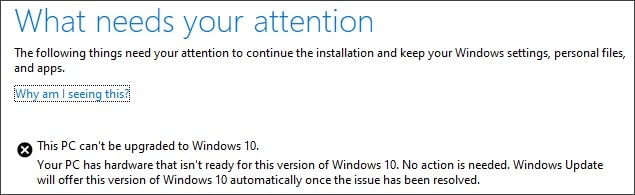
In a support article, Microsoft warns that some people may see an error message when they try to install the May 2019 Update. "This PC can't be upgraded to Windows 10" could be displayed if you have -- as many people do -- a USB device or SD card attached.

You can see what the error message looks like here:

Windows 10 May 2019 Update installation error

Microsoft explains that:

Inappropriate drive reassignment can occur on eligible computers that have an external USB device or SD memory card attached during the installation of the May 2019 update. For this reason, these computers are currently blocked from receiving the May 2019 Update. This generates the error message that is mentioned in the "Symptoms" section if the upgrade is tried again on an affected computer.

The company goes on to provide an example of what might happen:

Example: An upgrade to the May 2019 Update is tried on a computer that has the October 2018 update installed and also has a thumb drive inserted into a USB port. Before the upgrade, the device would have been mounted in the system as drive G based on the existing drive configuration. However, after the upgrade, the device is reassigned a different drive letter. For example, the drive is reassigned as drive H.

For now, the advice is to simply unplug the USB drive or SD card and restart the installation of the update, but a proper fix is in the pipeline. Microsoft says:

This issue will be resolved in a future servicing update for Windows 10. For Windows Insiders, this issue is resolved in build 18877 and later builds.

Image credit: Aquir / Shutterstock

Let's block ads! (Why?)


https://betanews.com/2019/04/24/windows-10-may-2019-update-external-drive-problems/

2019-04-24 10:32:20Z
52780274507077

New leak gives us our best look at the Google Pixel 3a - Phone Arena

The Google Pixel 3a will be officially unveiled in just a couple of weeks on May 7th at Google I/O, but you don't need to wait until then to get an up-close look at what could be the most impressive affordable camera phone.
Thanks to one of the most prolific leakers out there, Mr. Even Blass, we get a high-resolution render of the Pixel 3a (the photo below), and it basically corroborates all the earlier leaks about the phone.
The Pixel 3a pictured here features big bezels like it's 2017, but it's what on the inside that counts and on the inside you have this phone running on a clean version of Android that is likely to perform better than most rivals and unlike most other Android phones, this one is also expected to get regularly updated for quite a few years, so it will stay relevant in the long-term. At least, those are the expectations.
Newly leaked render of the Pixel 3a, the cleanest look so far

Newly leaked render of the Pixel 3a, the cleanest look so far

And what about the specs on the Google Pixel 3a?

Here is a short summary of everything that we know so far from rumors:

  • Processor: Snapdragon 670
  • RAM: 4GB
  • Storage: 64GB, no microSD
  • Battery: 3,000mAh
  • Charging: 18-watt fast charge
The big highlight of these phones, apart from clean Android, will surely be the camera. So far, rumors agree that the Pixel 3a series will have the same camera as on the flagship Pixels, which would be might impressive. Let us remind you that the Pixel 3 camera is one of the best of any phone out there as it performs great both during the day and at night.

Google Pixel 3a: Price and Release Date

Google Pixel 3a teaser

Google Pixel 3a teaser

The new mid-range Pixel phone is expected to arrive in two varieties: the small Pixel 3a and the bigger Pixel 3a XL. Both phones will be officially revealed over at Google I/O 2019 on May 7th.

And when it comes to prices, here are expectations based on rumors:

  • Pixel 3a 64GB: $400 / 450 euro
  • Pixel 3a XL 64GB: $500 / 550 euro

Interestingly, while the original flagship Pixel series were only available on Verizon Wireless in the United States, this time around, rumors suggest that both Verizon and T-Mobile will carry the new phones.

At these prices, the Pixel 3a series will beat the OnePlus family and will provide a solid alternative for those who don't want to spend a fortune on a flagship.

Let's block ads! (Why?)


https://www.phonearena.com/news/New-leak-gives-us-our-best-look-at-the-Google-Pixel-3a_id115548

2019-04-24 08:05:59Z
52780275947283

How to enable Google Chrome’s new dark mode on Windows 10 - The Verge

Chrome 74 is officially rolling out today for Windows, Mac, and Linux, marking the introduction of a new dark mode for Windows 10 users. The same dark mode arrived last month on macOS with Chrome 73, and today’s update includes automatic Windows 10 support. Chrome will automatically theme itself to match if a dark mode is enabled on Windows 10. The end result makes Chrome look almost identical to the browser’s darker Incognito Mode menu bars.

While Google is enabling this new dark mode on Windows, the company hasn’t fully switched it on for all Chrome users just yet. “I can confirm that we are rolling out this feature to a small number of Chrome M74 users now, and that it will become more widely available in the near future,” explains a Chrome community manager. If you don’t want to wait for Google to fully enable this, there’s a shortcut trick to force dark mode:

  • Find the shortcut you use to launch Chrome and open the properties
  • Add “--force-dark-mode” to the end of the target location (without quotes)
  • Launch Chrome and dark mode will be enabled. If you usually launch Chrome from a pinned taskbar item, you’ll need to launch with the shortcut trick and then unpin / pin again for this to hold

Chrome has always offered theme support to enable a dark mode of sorts, but this official mode now means that context menus are properly themed across the browser. Chrome 74 also includes a number of other changes that aren’t as obvious to spot visually. Chrome’s animation features can now be disabled to reduce motion sickness, and there’s a new flag to block websites from detecting Incognito Mode.

Chrome 74 is available to download from Google’s Chrome site, or from help > About Chrome if you’re already using the browser.

Let's block ads! (Why?)


https://www.theverge.com/2019/4/24/18512288/google-chrome-dark-mode-now-available-windows-10

2019-04-24 07:04:53Z
52780275676940

Selasa, 23 April 2019

Zotac GeForce GTX 1650 Gaming Review - Introduction - guru3d.com

Zotac Gaming GeForce GTX 1650 4G review 

We review the Zotac GeForce GTX 1650 Gaming, this incredibly small GeForce GTX 1650 has been fabbed to be a budget-friendly product, with an extremely small and compact size. We're talking less than 15cm here.  The single fan product is energy friendly as well, there's no need for even a power connector as it feeds from the 75 Watt PCIe power slot. 

The GeForce GTX 1650 will bear a minimum price tag of roughly US$ 179. These cards are fitted with 4GB GDDR5 memory based upon a 128-bit memory bus. While the clock frequencies of the GPU base and boost frequencies will vary a bit per board partner, the reference base clock speed is close to 1400 MHzWhen the first rumors on the GeForce GTX (yes, with a G) surfaced, speculation was everywhere and we had doubts NVIDIA would actually release a new GTX while moving forward towards it's RTX branding. NVIDIA is now injecting Turing based GPUs into the mainstream called TU116 and this new GU117. To make it more affordable NVIDIA stripped away the RTX and DLSS features, that means there are no RT and Tensor cores in these products. It's a fall back towards the original shader design model.

So to quickly recap; the 1650/1660 series is making use of the Turing architecture but will not have Raytracing and Tensor cores, this is why NVIDIA dropped the RTX suffix back to GTX. The GeForce GTX 1650 cards are to occupy a 149 to 179 USD price domain slash pricing level which coincidentally also is occupied by the AMD Polaris 20-based Radeon RX 570 series.


  GTX 1060 GTX 1650 GTX 1660 GTX 1660 Ti RTX 2060
GPU GP106 12nm FF TU117 12nm FF TU116 12nm FF TU116 12nm FF TU106
Shader cores 1280 896 1408 1536 1920
Memory 6 GB / 3GB GDDR5 4 GB GDDR5 6GB GDDR5 6GB GDDR6 6GB GDDR6
Memory bus 192-bit 128-bit 192-bit 192-bit 192-bit


The reference frequencies for the GTX 1650 series are quite decent, with a reference base and boost clocks at 1,485 and 1,665 MHz respectively. The new cards, (if priced right) will serve NVIDIA's entry-level to mainstream segment and should offer a capable 1080p solution. NVIDIA is not distributing a reference design card to the media. Ergo, the reviews you'll see are based on AIB designed partner cards. 

Zotac Gaming GeForce GTX 1650 OC 4GB

The 1650 series graphics cards are once again based on Turing architecture, offering just that fundamental shading engine. The GPU has been cut-down, the available memory configurations will be 4GB GDDR5 (8 Gbps) running a 128-bit wide bus. This 70 Watt rated graphics card has 896 active shader processors. It has a proper boost clock in the 1.665 GHz domain and there will be no differentiation for the reference values compared to the AIB partners. Having smaller TU117 silicon it doesn't run too hot and in fact, is really energy efficient. The cooler is following a dual-slot design. The card comes without any power connectors  (e.g. 8-pin PCIe). ZOTAC applies a very small cooler for the GeForce GTX 1650 which makes use of a single fan. It might not have any RGB embedded, but it still is an attractive product, easy to drop in. The card offers one of each, HDMI DisplayPort and DCI. This Turing 117 GPU empowered product keeps that GPU at roughly 60 Degrees C marker depending on game load. This compact card is based on an OC model, meaning a stock slightly tweaked Boost clock. The GDDR5 memory has been not been tweaked.

Let's block ads! (Why?)


https://www.guru3d.com/articles-pages/zotac-geforce-gtx-1650-gaming-4gb-review,1.html

2019-04-23 14:31:00Z
52780275222677

Intel’s new laptop processors hit the 5GHz mark - The Verge

Intel has announced a new suite of processors for high-end laptops that offer faster speeds and better connectivity options than prior chips. The new 9th Gen H-series processors, which have 45W power draws, compared to the 15W chips in thinner and lighter laptops, are available in Core i5, i7, and i9 versions and are designed for demanding uses such as gaming or content creation.

The star of the new chips is the Core i9-9980HK, which has a new top turbo speed of 5GHz, which is a rate that was previously unattainable in a laptop chip. It’s also unlocked, which means that it can be overclocked for even more speed. Like prior Core i9 chips, the 9980HK has eight cores and 16 threads and comes with 16MB of cache. In addition, the new chips support Intel’s latest Wi-Fi 6 networking cards, which can hit speeds of 2.4 Gbps.

Intel says the new processors provide up to 54 percent faster 4K video editing and a 56 percent improvement in gameplay compared to a three-year-old computer. The new chips are available in machines from Acer, Asus, Dell, HP, Razer, Lenovo, and MSI starting today.

Intel has also expanded its range of 9th Gen chips for desktops to more than 25 different CPU options across the Celeron, Pentium Gold, Core i3, i5, i7, and i9 lineups. The new Celeron and Pentium Gold designs are the first 9th Gen chips in those families and should give a boost to low-end, entry-level computers.

All of these new chips are still using the 14nm process, which Intel has been stuck on for a few generations. Theoretically, the company is expected to move to a newer process later this year, which should provide more improvements to performance and efficiency.

Let's block ads! (Why?)


https://www.theverge.com/2019/4/23/18512501/intel-9th-gen-laptop-desktop-processors-5ghz-update-specs-speed-features

2019-04-23 14:31:30Z
52780275427516